
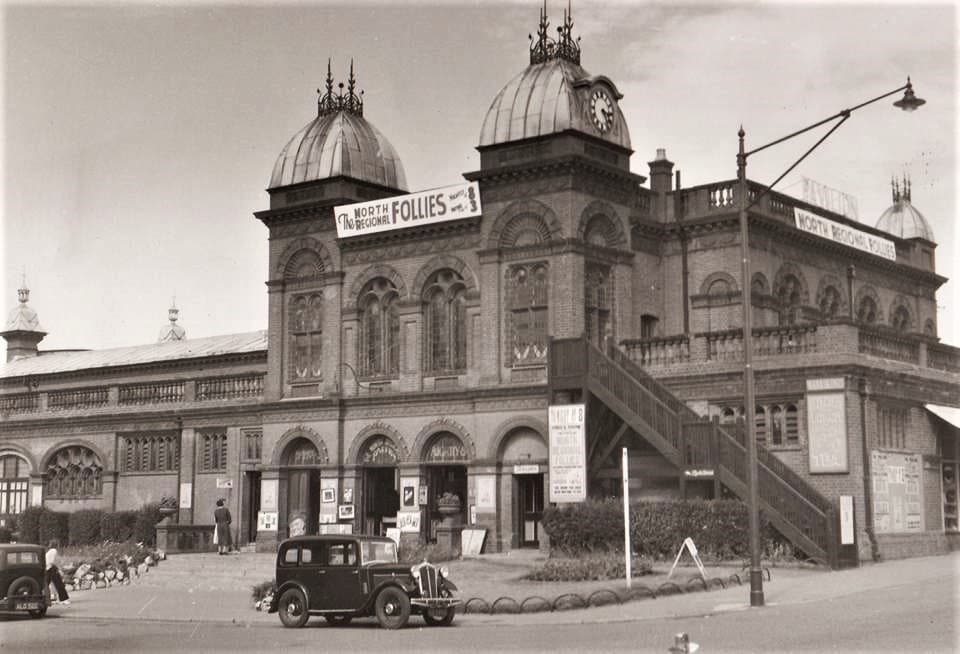
A Gorleston landmark since 1901
Built for a town becoming a seaside resort
- The Pavilion opens
- 1901
- A remarkably versatile venue
- Stage, screen & radio
- Celebrated in 2026
- 125 years
The Pavilion through time
Scroll sideways to explore the people, performances and turning points that shaped the theatre.
The Pavilion opens
J.W. Cockrill's Italian-style terracotta building opens as part of Gorleston's transformation into a seaside resort.
Wartime occupation
The building is occupied by the Army during the First World War before returning to entertainment and cinema.
A theatrical landmark
Cinema owner Frederick Cooper adds the ornate proscenium arch that remains one of the auditorium's defining features.
The concert-party years
The theatre flourishes with summer entertainment led by performers including Helen Hill and the legendary Gert and Daisy.
Bill Pertwee makes his debut
The future Dad's Army star begins his professional career in the Pavilion summer show—and very nearly gets the sack.
The BBC comes to Gorleston
The Pavilion becomes a radio studio for recordings of The Clitheroe Kid and The Harry Worth Show.
A new kind of summer show
The concert-party era ends and the theatre turns to old-time music hall, with tables and chairs in the auditorium.
Saved by its community
When Council subsidy ends, a local community association steps in and helps prevent the final curtain from falling.
Entertainment all year round
Carl Adams, followed by Stuart Malkovich and Kevin Lynch, expands the programme beyond the traditional summer season.
The Trust takes over
The Gorleston Pavilion Trust completes its takeover and begins planning for the building's long-term restoration and future.
125 years by the sea
The Pavilion celebrates 125 years as a place for live entertainment, community activity and shared memories.
Watch: The Pavilion at the heart of Gorleston
Gorleston Library · 15 May 2026
This film records a special event held at Gorleston Library, exploring the Pavilion Theatre's history and its place in the cultural life of the town.
Led by AJ Haworth and the Gorleston Library Friends, the talk features Tony Mallion and Alex Youngs sharing stories about the people, performances and community spirit behind one of Gorleston's best-known landmarks.
The stories behind the dates
The Pavilion's survival has depended on ambitious ideas, memorable performers and generations of local people willing to give the building a new purpose.
An ambitious beginning
The original Shelter Hall was not universally welcomed. Some councillors argued that the money should be spent on housing improvements instead, but the Pavilion plan survived. Keith Prowse—later famous for his ticket agency—became the first lessee and presented band concerts. He was followed by George Gilbert, the showman behind the Hippodrome circuses in Great Yarmouth and Lowestoft, who also screened films in the remarkably adaptable building.
“It always seemed sunny and the auditorium's sliding roof was often open. There was usually a full house—locals and visitors alike.”
Recollection of a local resident from the concert-party years
Summer shows and a very close call
The theatre came through the Second World War despite being close to the front line. By the mid-1950s its summer programme was still creating careers. Bill Pertwee made his professional debut in Henry Lutman's Summertime in 1955, arriving with an ambitious collection of props but very little material. He had also failed to realise that the programme changed five times during the season, leaving veteran comedian Clifford Hensley to help him through it.
Several cast members—including Marion MacLeod, who later became Pertwee's wife—wanted him dismissed. Lutman kept him partly because a replacement could not be found at short notice and the costumes would not fit anyone else. Years later, seeing his name in lights in the West End, Pertwee reflected that being sacked in Gorleston could have ended his career before it began. His portrait still looks down from the Pavilion foyer.
From music hall to broadcasting
Concert-party shows continued until 1962, when Frieda Hall and her family presented the final season. Old-time music hall followed, complete with tables and chairs in the auditorium and Cavan O'Connor singing his trademark song, I'm Only a Strolling Vagabond. Around the same time, the Pavilion became a BBC radio comedy studio. The adjoining amusement park was paid to remain silent while The Clitheroe Kid and The Harry Worth Show were recorded. Decades later, television returned when the BBC launched the DIY programme Change That from the theatre.
Saved and expanded by the community
The early 1980s brought what appeared to be the final Council-run summer show. When the subsidy ended, a local community association stepped in and local entertainer Carl Adams took over. He ran the Pavilion for ten years, expanded its winter use and helped turn a seasonal venue into a year-round theatre. Stuart Malkovich and Kevin Lynch later broadened the programme further, welcoming both amateur companies and professional performers.
Kevin Lynch's death in January 2023 activated the succession plan he had developed with Stuart. In February 2024, the Gorleston Pavilion Trust completed the takeover and began planning the long-term work needed to protect the theatre for another generation.
Historical account adapted from an article by Tony Mallion.